
Children helping in industrial and farm labor and ordinary kitchen drudgery primarily to save expense, not to train the boy or girl for a useful occupation were in “vocational rehabilitation.”
Albert Deutsch, Our Rejected Children (1950), 15.
While nominally a “school,” Vermont’s juvenile reformatory was also a place of work. Early inmates were instructed in basic literacy (the better to read the Scriptures, among other texts) and basic arithmetic (the better to spend and save wisely and avoid becoming a public charge). But equally if not more importantly, “bad” children were transformed into “good” citizens through hard, manual labor. In prioritizing manual labor, whether in the chair shop or on the farm, the reformatory’s founders acted on the belief that juvenile offenders, though less vicious than adult criminals, nevertheless benefited from a work regimen comparable to that imposed on adult prisoners. Like adult criminals, the institution’s founders argued, child inmates must pay their debt to society through hard work; their ability to re-enter society was contingent on demonstrating compliance with overseers’ stringent demands.
Throughout its 114-year history, Vermont’s juvenile reformatory was perennially underfunded. Superintendents’ reports are filled with pleas to the legislature for increased funding and with apologies when expenditures exceeded scant allocations. Using inmate labor not only had punitive value; it also offset institutional costs and added to the institution’s coffers. Particularly as farm workers, inmates were financial assets to the institution. Administrators were sometimes loath to part with good workers, who might find their sentences extended in order to preserve their value to the institution.
The precise value attached to inmate labor changed over time and can be discussed in relation to three rough periods: the Reform School years (1865-1894); the Industrial School years (1895-1937), the Weeks School years (1937-1979).
Work at the Vermont Reform School
In his 1868 report to the Board of Trustees, Superintendent A. G. Pease included the table to the right, which lists inmates’ “moral and domestic conditions before commitment.” Among the conditions calling for reform was the fact that “nearly all” inmates “were mostly idle, prior to commitment.” The same pervasive idleness would be noted in subsequent reports.

At the time of Pease’s report, child labor was an accepted fact of life, particularly among the nation’s poor. In spite of increasing support for universal public education, poor children were often compelled to work rather than attend school. Even as late as 1890, more than 18 percent of U.S. children ages 10 to 15 were employed (Trattner, Crusade for the children, p. 36). When Pease noted that “nearly all” inmates were “were mostly idle, prior to commitment,” he was commenting their lack of gainful employment. A large part of his work, he believed, was preparing young inmates to be good workers upon their release. During the institution’s Waterbury years (1865-1874), inmates completed many tasks required to keep the institution running smoothly, from working in the kitchen and laundry to maintaining the building and grounds. They also spent several hours each day in two primary occupations: the farm and the chair shop.

Originally, the Vermont Reform School was sited on farmland in Waterbury, Vermont, as this detail of an 1873 town map illustrates. Under the supervision of an experienced farmer, inmates tilled the fields, sowed and harvested crops, and tended livestock. As Superintendent Pease enthusiastically wrote to the trustees of the school: “It can hardly be questioned that the raising of crops upon the land . . . is the most healthful and profitable employment for [the boys].” The farm garnered Pease’s enthusiasm because it contributed “largely to the support of the school.” He advocated purchasing more acreage to enhance the farm’s profitability (Pease, 1868, 7).
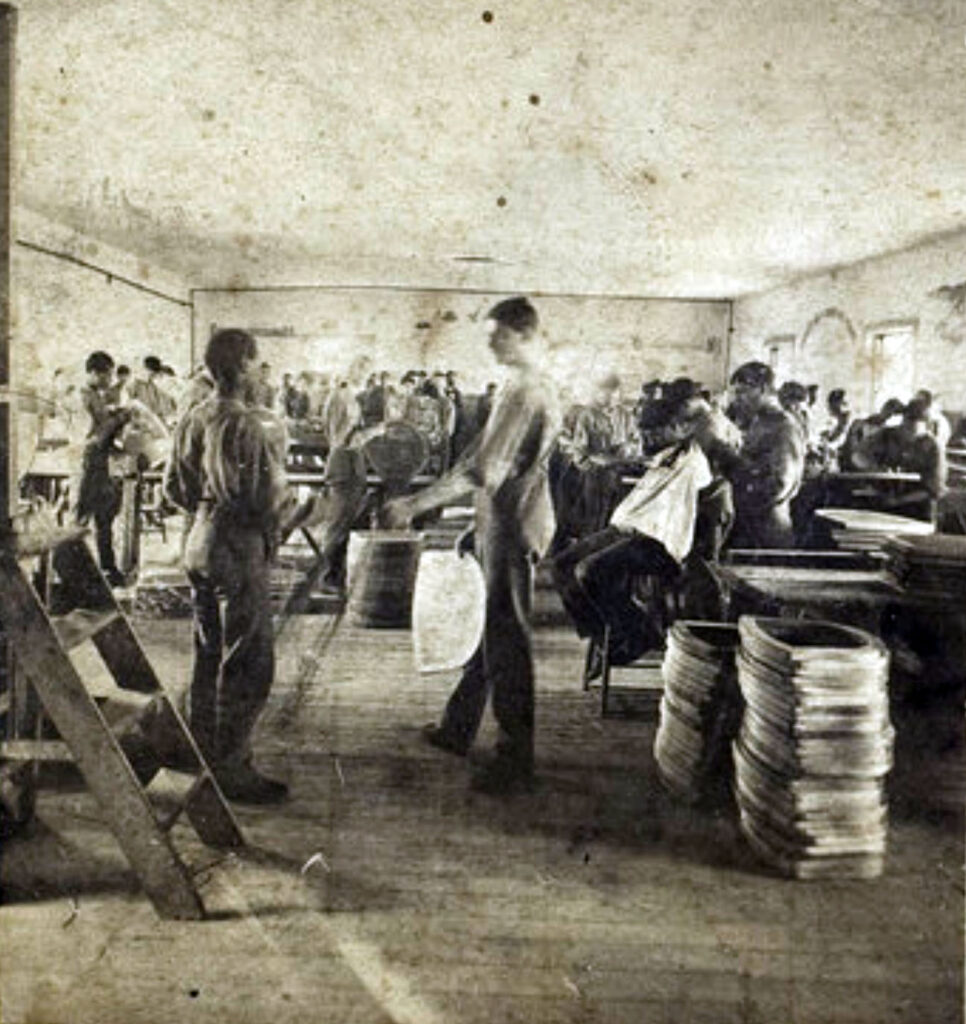
If farm work was the most profitable use of inmate labor, it was also seasonal. Work in the chair shop had the advantage of utilizing inmate labor year-round. On the 1873 map, the W. G. Fairbanks Chair Factory appears just to the southwest of the Reform School. The factory’s proximity to the institution was not coincidental. The factory’s owners contracted with the Reform School to have inmates make cane seats for chairs. The income generated by inmates’ work in the chair shop was used to offset the institution’s operating costs.
The earnings from the chair shop were variable. As Superintendent Fairbank wrote in 1882, “The earnings in the shop have not been as great as they would have been had not so many boys been required to assist in the work of building, grading, making roads, etc., but it the ‘pennies saved’ were placed in the account, our earnings would be greatly augmented” (Fairbanks, 1882 Biennial Report, 53). In fact, while early reports indicate that younger boys worked in the shop for roughly four hours (and older boys presumably longer), inmates were frequently pulled away from the chair shop to labor elsewhere at the institution.
While no known photographs exist of the chair shop at the Vermont Reform School, the shop at the Reform School in Westborough, Massachusetts depicts a similar operation. As the oldest reform school in New England (established in 1848), the Westborough institution was the model on which the Vermont Reform School was founded. Notably, reports of cruel and unnecessarily severe punishments at the Westborough Reform School led to its closure in the early 1880s – a significant fact given evidence of abusive treatment by overseers at the Vermont Reform School.
Just as inmates’ work on the farm was supervised by an experienced farmer, the chair shop at the Vermont Reform School was managed by an overseer. The overseer’s methods reflected the broader punitive approach of the institution. For example, in 1874, 15-year-old inmate Warren Johnson described how Overseer Edward T. Healey repeatedly whipped him until “the blood ran down his legs.” Notably, Healey was not reprimanded for his cruelty; in fact, in addition to overseeing the chair shop, he served as Assistant Superintendent for many years, eventually becoming Superintendent in 1886.
Healey was not alone in using brutal methods to compel inmate labor in the chair shop. A. B. Allen, who succeeded Healey as overseer, also physically abused inmates. Allen took his punitive approach too far in 1878 when he killed 14-year-old George Valiquette by first whipping him and then throwing him down a flight of stairs. Valiquette’s death brought unwanted attention to the institution and Allen was temporarily taken into custody. However, to the dismay of Valiquette’s friends and family, his death was ruled an accident. Inmates who witnessed the lethal punishment were understandably reluctant to testify against Overseer Allen.
Girls’ work at the reform school

After fire destroyed the Reform School’s Waterbury campus in December 1874, the institution was relocated to Vergennes. In January 1876, a girls’ department was added. While boys worked in the chair shop, on the farm, and in “filling and grading about the buildings, arranging walks, flowers, and fountains, adding largely to the beauty of the grounds,” female inmates were “equally industrious in their work, making and repairing their own garments and those of the boys, with all the other sewing necessary for the institution” (1880 Biennial, 5). Under the guidance of the head matron and other female officers, girls also baked bread, prepared meals, cleaned, canned farm produce, and engaged in other domestic chores essential to the smooth operation of the institution. This regime of domestic labor had moral as well as practical advantages, teaching girls who “were terribly vicious, dirty, and diseased… [to be] cleanly and correct in their persons and…obedient, industrious, and trustworthy” (2 Feb 1880, 2 – Orleans County Monitor). Properly trained girls could be hired as domestic servants in the homes of “good families” whose ranks they could never join as equals.
Inmate Labor during the Industrial School Years (1895-1937)
In 1894, the Vermont Legislature voted to change the institution’s name from the Vermont Reform School to the Vermont Industrial School. Advocates of the change argued that “Vermont Industrial School” better represented the institution’s commitment to instilling moral and occupational competence in inmates, thus preparing them to function as responsible members of a modern, industrializing society. If “Vermont Reform School” conjured backwardness and harsh punishment in the public mind, advocates for the “Vermont Industrial School” hoped that the new name would conjure a more modern and humane alternative.
In fact, the name change made little difference in inmates’ daily lives. While officers paid lip service to preparing inmates for diverse roles in a modern, industrializing society and an honor system ostensibly replaced the old regime of corporal punishment, male inmates still devoted the bulk of their time to farm work and chair making and female inmates continued to perform domestic tasks. Moreover, poor performance or misbehavior was still likely to result in physical discipline and solitary confinement.

One noticeable difference in the Industrial School era (1895-1937) was an even greater preoccupation with farm production, prompting some observers to wonder whether the farm existed to serve the school or the school existed to serve the farm. In part, praise for the Industrial School farm reflected growing public ambivalence about industrialization, urbanization, and immigration — all of which prompted nostalgia for a idealized vision of nineteenth-century white agrarian settlement. Even in predominantly rural Vermont, concerns about vice-prone immigrant children roaming unsupervised in cities and larger towns enhanced support for the agrarian Industrial School.
The institution’s Vergennes location was widely praised for its pleasant bucolic setting. One visitor described the campus as “located on the banks of the winding Otter Creek, one of the most delightful spots I have ever seen” (Horace W. Bailey, 1899). Another wrote: “The Vermont State industrial school is very pleasantly located on a high bluff overlooking the beautiful Otter Creek, near the head of lake navigation, and in sight of the great falls.” While the grounds fell “within the city limits of Vergennes,” he continued: “It is on the very outskirts of the city, however, so . . . it has all the quiet and healthful surroundings of the country. Very few schools have a more delightful location” (BFP, 9/22/10).
Celebrating the farm
Adding to the wholesome and picturesque image of the Industrial School were its farming operations. A 1915 article for The Vermonter Magazine described the farm buildings this way: “From the Administration Building, stretching north to the top of the hill, lie the farm buildings–hoggery, hennery, horse-barn, wagon sheds, etc., to the big new stock-barn at the very top.” This final building “command[ed] a wonderful view of the school and the surrounding country” (182-83). Its impressive size and hilltop location were fitting, given the priority placed on farming relative to all other aspects of institutional life.
Once print technology enabled superintendents to include photographs in their biennial reports, they often featured pictures of farm buildings and livestock. An example from the 1896 biennial report appears below.
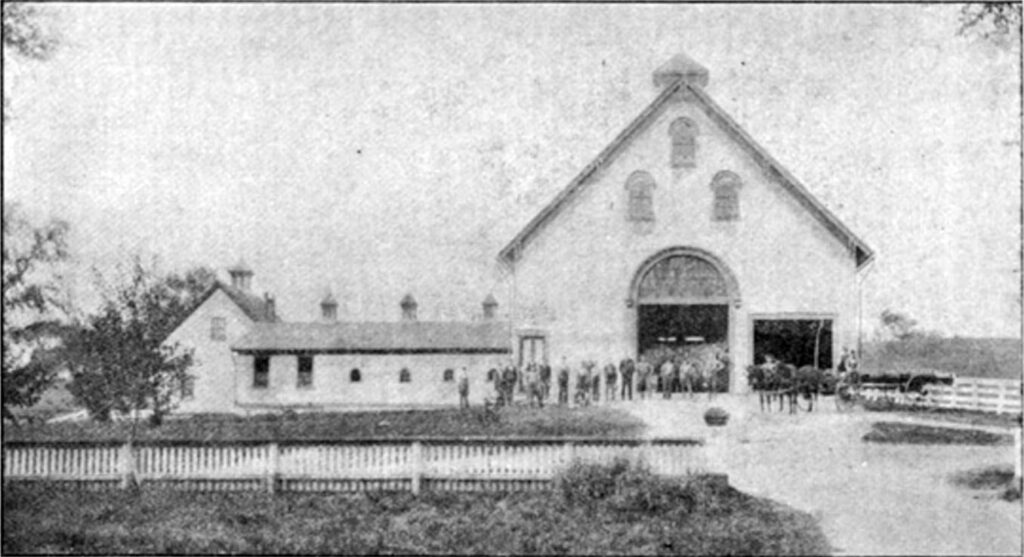
As one supporter of the institution approvingly wrote, “[T]here is a complete set of farm buildings nearly all new and specially adapted to the work of the school. The farm now contains about 200 acres of rich land….” (Rutland Daily Herald, June 1, 1906, 3). Over time, the institution’s land and livestock holdings grew; the Legislature willingly allocated money for farm buildings and equipment even when other buildings were overcrowded and poorly maintained.
On the one hand, legislators approved funds for the Industrial School farm because they believed it would yield a good return on their investment. And it did. As one newspaper editor wrote in 1906, “This branch of the school brings in a good revenue, nearly $2,000 being realized during the last year” (St. Albans Daily Messenger, 29 May 1906, 1). Legislators were less enthusiastic to allocate funds to relieve overcrowding, improve sanitation, or otherwise contribute to inmate well-being.
Indeed, while legislators heaped praise on the Industrial School’s prize-winning dairy cows, they evinced less enthusiasm for the human beings who were compelled to live there. Two photographs from the 1902 Biennial Report illustrate this relative valuation: one foregrounds a group Ayrshire cows in a field with campus buildings in the distance; another shows a boys’ cottage in which the building, not the boys, is highlighted. (If you look closely, you can see a few boys clustered near the building’s foundation and perched on the steps. A man – likely the cottage master – occupies one of two porch chairs; the other is empty, likely reserved for his wife who served as cottage matron).


Of the cottage itself, two statements in the 1902 Biennial Report are noteworthy. First, in explaining how the building was prepared for its use as a cottage, Superintendent Andrews wrote: “The work of excavating, quarrying and drawing stone, as well as the common carpenter work and painting, was done largely by the older boys.” The resulting cottage, he added, was purely utilitarian: “It is not elaborate in finish nor has it expensive fixtures, but it answers the requirements.” Thus, while claiming to give inmates a better home than the allegedly vicious, undoubtedly poor families from which they came, Industrial School officers compelled children to perform arduous labor (e.g., quarrying, drawing stone) while housing them in residential buildings that “answered the requirements,” but were cold and sterile at best.
While the Industrial School officers and their supporters paid lip-service to preparing boys to work in a variety of occupations, the primary training boys received was how to work on the farm. Needless to say, this emphasis dovetailed with the institution’s financial interests, but it also fit with officers’ conviction that farm work had a salutary impact on delinquent boys. Not only was it a corrective to delinquent boys’ idleness and dissipation; it also prepared them for adult lives of drudgery and low status. Expressing his low estimation of inmates’ prospects, Superintendent Andrews wrote in 1902, “Many of [the boys] must necessarily become ‘Hewers of wood and drawers of water,’ and what they learn of general farm work, the care of teams and stock will be of help to them” (Andrews, 1902 Biennial Report).
Others put a positive spin on the farm training that male inmates received, touting its benefits both to the boys and to Vermont farmers who would welcome a ready supply of trained farm hands. According to The Vermonter, “farm-work,” together with “good food” and “regular hours,” transformed “[h]ard, tough-looking specimens of boyhood” into “bright-faced manly lads who stand erect and look fearlessly into your eyes” (A Moral Hospital, 1915, 185). Noting that “Farm help is very scarce that is good for anything,” The Rutland Daily Herald praised the Industrial School for providing a vital resource to the state.
Even the institution’s youngest inmates were required to work in the fields, and topics related to farming entered the institution’s “academic” curriculum at a very early age. In 1910, the Burlington Free Press approvingly wrote: “Nature study is taught objectively in the first, second, and third grades, followed by study soils of plant life, animal life, etc., culminating in instruction in soils, fertilizing, feeding, rotation of crops and animal husbandry, by the class in agriculture, the largest many times over in the school” (“At the Industrial School,” 9-20-1910). Thus farm work merged with (and too often displaced) traditional academic learning at the School.


A handful of photographs showing young inmates engaged in field labor survive from the early 1900s. It’s not clear by whom or for what purpose they were taken. Distinct from public relations photos that appeared in official publications, the meanings contained in these photos are open-ended. How old do the subjects appear to be? What can we conclude about their relationship to adults in the images? How is each child in the photographs distinct from, and what do they share in common with, the others? What is their apparent attitude toward their surroundings and the work they are performing? How do the photographs both complement and contest other information sources about inmate life and labor at the Industrial School?
Domestic work at the Vermont Industrial School, 1895-1937
If male inmates were compelled, even at young ages, to labor in the fields of the Industrial School, female inmates were required to perform domestic labor. They cleaned, baked, prepared meals, and canned farm produce. Each girls’ cottage also had a sewing room where girls made and mended inmates’ clothing under the watchful eye of a female overseer. While Industrial School girls received altogether less attention than boys, an occasional news article lauded their domestic accomplishments. “GIRLS OF SCHOOL GOOD COOKS,” proclaimed the Burlington Free Press in October 1912; several years later, The Brattleboro Reformer declared:
When a girl goes out of the Industrial school … she knows how to do things. She has learned the laundry end by working on the 1,600 pieces which go through their monthly, and the mending end, where 1,800 garments and other pieces are repairs in the same length of time. The girls make their own dresses and underwear and make the overalls and trousers for the boys. All the bedding and other material used in the institution is made by the girls.
“Production,” Brattleboro Reformer, October 26, 1925, p. 5.
The following account, published in a 1913 issue of Echoes, describes the weekly work schedule in one of the girls’ cottages:
Monday is used for general housework. We repair all of the girls’ clothing and also make new garments…
“Our School at Work,” Echoes, May 1913, 6-7.
Tuesday morning we do the regular house-work. The boys’ stockings are then brought in, 310 in all. They are sorted, mated, and checked. Then we begin the mending and it must be finished by Thursday evening. Besides this we do new work on clothes…
Wednesday we darn the boys’ stockings and do regular household duties such as ironing and so forth…
Thursday the boys’ stockings are finished and checked off ready for their return to the different divisions…
Friday the girls mend, do new work and cooking for over Sunday…
Saturday is our general house-cleaning day. Everything is cleaned from dormitory to basement. The windows are washed and the floors cleaned and oiled…
Just as farm work was believed to have a salutary effect on male inmates, transforming “tough-looking specimens of boyhood” into “bright-faced manly lads,” domestic labor was believed to transform “wayward girls” into compliant household servants. Still, administrators worried that female inmates could never be wholly reformed. Unless such girls were placed in good households and subject to “systematic supervision” upon their release, Dr. Frederic W. Sears wrote in 1912, they would be vulnerable to “every lecherous loafer on our streets” (Sears, 8). Barss and Wilson, who superintendent the institution from 1907 to 1930, agreed with Sears that the safest way to ensure female inmates’ virtue was to sterilize them. Their views on the eugenic threat posed by delinquent girls were thwarted, however: first when a 1912 sterilization bill was vetoed by Governor Allen M. Fletcher, and then when the ongoing campaign for eugenic sterilization failed to become law until 1931.
While domestic servitude would not prevent former female inmates from falling prey to “lechers,” it did reinforce their low social status. As Sears wrote in 1912, female inmates “with very few exceptions are fitted only for the lower walks of life and any ill-judged attempts to raise them higher would result disastrously both to themselves and to their associates” (Sears, “The Wayward Girl, p. 8). Thus, if boys’ farm work prepared them for lowly status as “hewers of wood and drawers of water,” girls’ domestic work similarly prepared them for an equally low, if not lower, station in life: as servants in Vermont households, but not as householders themselves.
Labor and Learning at the Weeks School (1937-1979)
Back in the 1890s, changing the institution’s name from “Reform School” to “Industrial School” was motivated, in no small part, by a desire to differentiate the institution’s humane and smoothly functioning present from its brutally punitive past. Likewise, the decision to change the name to “Weeks School” in 1937 reflected a desire to put several tumultuous years, punctuated by investigations into maladministration and brutality, in the institution’s rear-view mirror. Unfortunately, the name change did not have the desired effect. The Weeks School continued to be hobbled by periodic allegations of abuse and mismanagement. Among the frequent criticisms levied against the Weeks School was its over-emphasis on productive labor — especially farm work — and its corresponding neglect of inmates’ social and educational needs.
In spite of a rhetorical shift toward improved education and rehabilitation of inmates, the newly renamed Weeks School continued to rely heavily on male inmate labor to maintain its extensive farm operations. Depression-era austerity, followed by wartime manpower and resource shortages, incentivized increased farm production while making the hiring non-inmate farm labor difficult.
Of course, forced farm labor was only one of several problems besetting the institution in the late 1930s and 1940s. Allegations of frequent and brutal beatings — often administered for poor work performance — continued for more than a decade after the institution was renamed the Weeks School.
One of the most sensational moments in Weeks School history occurred in 1944, when allegations of brutality prompted a third major investigation of institution practices in less than a decade. Governor Mortimer R. Proctor enlisted juvenile corrections expert Roy L. McLaughlin of Meriden, Connecticut to lead the investigation. McLaughlin’s report, released in April 1944, prompted extensive public commentary and debate. In it, McLaughlin documented inadequate staff training and supervision and the routine use of harsh physical discipline and solitary confinement to manage inmates. As concerned as McLaughlin was by these abuses, he was equally alarmed by the emphasis placed on farming at the expense of other vocational, academic, therapeutic, and recreational programs. He wrote: “An institution farm is a two-edged sword, particularly at a correctional institution for youth.” He elaborated: “the more farm-minded a staff becomes, the less boy-minded it is.” McLaughlin recommended that the Weeks School refocus on “other needs that [are] more important but which do not indicate the prospect of a direct return for money invested.” Among those needs was a recreational program, which might include campus movie screenings. Of course, for inmates to enjoy leisure activities, they would have to work less. Thus McLaughlin asked, “why not cease work at noon on Saturday? A six-day week includes overtime in industry and seems too much to ask of young people” (McLaughlin Report, 14). An end to beatings, less farm work, and more leisure: these recommendations were central to the McLaughlin Report.

McLaughlin’s report prompted Superintendent Carpenter’s resignation and the firing of some staff members for abusing inmates. Given its broad public airing, one might have thought that it would bring about a reduction in farm labor as well. Newspaper articles published in 1947 and 1948 suggest otherwise. Noting the absence of a diversified vocational training program in 1947, a writer for the Rutland Daily Herald commented, “With a 700-acre farm to operate . . . most boys were needed to carry on the farm work” (McWhorter, RDH, 10-29-47, 6).
When Hollis Blodgett became superintendent in August 1947, he hoped to finally minimize the farm program. He criticized the existing marking system at the Weeks School, which he described as “a means for keeping youngsters imprisoned for years on end. Thus they were developed into capable farm hands on the school’s farm and exploited for the revenue they were capable of producing” (1 Feb 1948, 2 – Vermont Sunday News at Newspapers.com). Blodgett did not see his job as retaining “capable farm hands” but as preparing inmates for release into an occupationally diverse world. He stated, ““I believe now that they’re going to have to sell the farm, or most of it. I’m not running a farm, but a place where youthful delinquents can be rehabilitated” (Ibid). Reacting to Blodgett’s public statements, the St. Albans Daily Messenger declared,
The young people do not exist for the sake of the farm, on the contrary the farm exists for the sake of the young people. Nothing could possibly be more unfair than to retain a boy longer than he ought to be retained simply because he happens to be useful around the barn.
Ritchie Low, “Changes at the Weeks School, St. Albans Daily Messenger, Feb. 13, 1948, 4.
In spite of his resolve, Blodgett lacked political support for his plan to scale back the farm and reduce the inmate population through parole. He resigned in frustration after two years, continuing the pattern of administrative discontinuity that plagued the Weeks School throughout the 1930s and 1940s.
Blodgett was replaced by Superintendent Harrison Greenleaf, who shared his humanitarian views but possessed greater political acumen. “The institution is a child caring agency, not a reformatory, and does not exist for the purpose of inflicting hard labor or punishment on boys and girls,” Greenleaf declared in 1953. Farm work was apparently de-emphasized under Greenleaf, who succeeded in reducing the total acreage under cultivation. To be sure, farm work remained a mainstay of vocational training for male inmates, but academics, recreation, group therapy, and other activities played a larger role. Describing vocational training in 1964, Greenleaf stated, “Student training … includes work done in their home cottages in housekeeping duties, all phases of food preparation at the main school kitchen, and farm work on the model farm” (Feb 1964, 6 – Addison County Independent).
As the Weeks School entered its final decade, farming operations continued to be a contested feature of institutional life. According to a 1969 article in the Burlington Free Press, the Vermont Legislature was still debating the utility of farm holdings at the Weeks School and other state institutions. “The value of farm work for inmates and patients has decreased to an all-time low,” the newspaper reported. Male inmates at the Weeks School preferred to train as auto mechanics, not to work on the farm. (Burlington Free Press. “Legislative Group Urged to Retain 4 Farms,” September 9, 1969). The article quoted Charles Adams, a former inmate and current Corrections Commissioner, who had worked on the Weeks School farm in his youth. Adams stated that “youths aren’t interested in farming and should be given training choices,” adding that “placement of youths on family farms is difficult.”
Conclusion
When the Weeks School closed in 1979, many commentators welcomed the demise of an institutional “dinosaur.” In its longstanding commitment to pressing boys into farm labor and girls into domestic work, the institution was remarkably old-fashioned. In spite of name changes, declared policy shifts, and periodic scandals, the institution remained remarkably consistent in its commitment to instilling gender-specific work habits in the children under its supervision. Another consistency was its recourse to harsh physical punishments when inmates’ work or behavior was unsatisfactory. While Greenleaf declared in 1953 that the institution “does not exist for the purpose of inflicting hard labor or punishment on boys and girls,” he was speaking a partial truth. Hard labor and punishment might have waned in the final years of the Weeks School, but they certainly never disappeared.
